

Skrevet i 2015, offentliggjort via Medium første gang
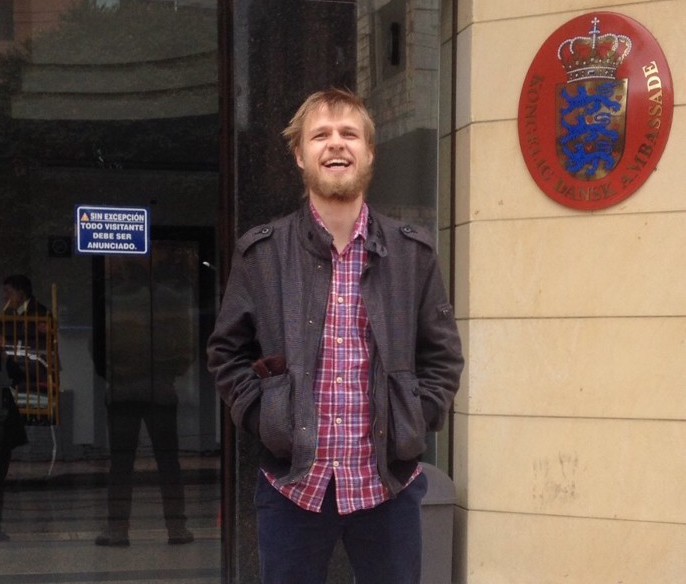
All my Colombian friends, thought I was joking, when I told them that I would be going 484 kilometers from Medellin to the capital of Bogota, where the Royal Danish Embassy is based, ‘just’ to vote in the government elections. Five years ago it is unlikely that I would have crossed a mountain range on a 10 hours bus ride with this sole purpose.
As a Dane, I have been privileged to be raised within a democracy. Though my family was not the most politically engaged, I was educated with the belief that voting is not only a right, but an obligation if you hope to change anything. So it would be no surprise when my second cousin wrote me days before to remind me that I had to vote – for the sake of democracy.
The first time I voted in a government election, I was 20 years old. I knew enough of the basics to differentiate the right leaned parties from the left ones. Even so, I felt disconnected from the politicians and not to say the least, their visions. I don’t believe I’m alone in this sentiment either. Political apathy among young Danes is very real. Politicians exacerbate this apathy every time they start to unconvincingly make their marketing pitch about the future and indulge in the practice of politically bashing their competitors. Quite simply, they have become untrustworthy.
Democracy is built on trust
In Colombia only 8 % of the population trusts the politicians. It is easy to argue that this extremely low percentage is tied to a high degree of corruption the country has grappled with for the last couple of decades. Yet in the current electoral campaigns in Denmark, a so-called developed country, the trustworthiness of politicians is also one of the most debated topics. Various polls from 2014 have showed that less than 40% of the Danish population trust their politicians. It may be difficult to compare two countries with such different historical backgrounds, I admit it. Nevertheless, I find it curious that both countries, with political systems based on democracy, have such a strikingly low trust in the “democratically” elected politicians. The question is whether the context within which we have historically created democracy remain appropriate today? No doubt, democracy is a fickle thing.
Politics has become a subject for very few people within a very limited educational and social scope and not as it should be the catalyst stone for the democracy reflecting the voice of the citizens. The irony is that many young people are motivated to be the change, but the nature of politics can be very disenchanting and leads most young people to surrender to apathy. There is little to no connection between their daily lives and the current framework of politics, making it hard if not impossible for them to identify with the political visions.
Do we have an alternative?
Over the last couple of years, political parties such as Podemos (We can) in Spain, Partido de la Red (The network party) in Argentina and Alternativet (The alternative) in Denmark, have emerged with a mission of pushing for a more participatory version of democracy. The latter mentioned, Alternativet, has been criticised for what have been called ‘utopian’ proposals. Notions of reaching a 100% ecological agriculture, a weekly vegetarian-food only day in public schools, and a 30-hours work week (compared to the current 37-hour work-week in Denmark) are all part of the plan to ensure their vision of a greener and more sustainable society.
In spite of the skepticism and even laughter in the face of their attempt to surpass the 2% mark for entering the Danish parliament, it now seems as if they come into the upcoming elections with some clout. The current pronostics show that the party will end up with between 4 to 5% of the votes – an impressive result for a new party in Denmark. In addition, the party seems to pull ahead of traditional parties (e.g the conservatives) and may very well tip the balance in favour of the current Prime Minister, Helle Thorning, ensuring that she remains the head of the small country for another four years. But then, considering the amount of criticism they initially received, how did these renegades gain favorable public opinion ahead of the June 18th elections?
The answer may be simple enough. In the backdrop of untrustworthy parties, Alternativet has managed to convince Danes that of an alternative political culture. One characterized by less distance from citizens to the politician and more focus on solving actual societal challenges. There is no predetermined set of guidelines to how society and should be working, but instead – Alternativet relies on a broader collaborative approach making use of so-called political laboratories in which every citizen can participate to form their political program. Another keystone for the party, is the proposal of a fourth sector. The current private, public and voluntary sector cannot on their own solve the social and environmental challenges facing the society. Instead, collaboration and innovation are needed. Combining the best of the three of three sectors is the alternative way to come up with sustainable solutions.
Collaboration is key to the succes of democracy
Collaboration for me is key to the success of democracy. We have and share opinions, we learn from each other and we take the best of it to develop our society. It sounds easy, but in the end, I think many people vote without much clue of why they vote for the person or party they vote for or they simply do not vote. Think about it. So many work their asses off to sustain and improve the conditions in our society. Yet, only very few are involved in the actual decision-making process on how to build the society we want.
After my long journey, and a couple of mentions on looking like the local Antanas Mockus – a well-known, controversial and generally respected Colombian politician – I did finally cast my vote with confidence. I decided to give the alternative a chance, not because I agree with every single element of their program, but because I believe that a more collaborative society in which we can learn from and share with each other across sectors, borders and generations, will also lead to higher degree of participation amongst all citizen, a better understanding of each other and hereby a more appropriate form of democracy.